Many voices.
One useful brief.
I built VoiceBrief to turn scattered feedback into a first-pass strategy you can question, inspect and take away.
“I love it. Except for the setup.”
“Worth the price?”
“This is the part I use every day.”
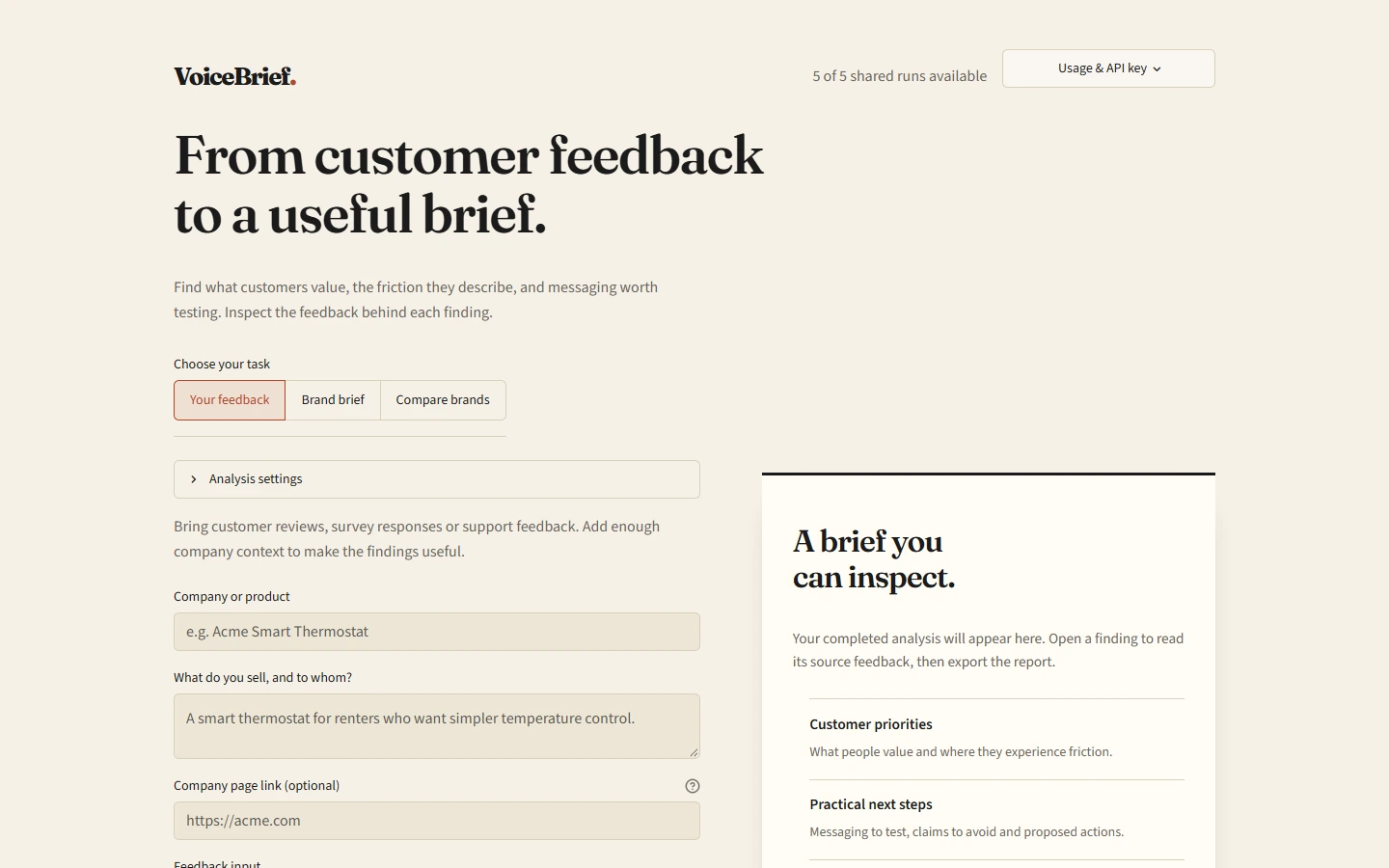
Paste responses, upload a CSV, or collect a sample of public comments.
Read priorities, friction and messaging hypotheses alongside their cited feedback.
Export the analysis, limitations and source appendix as PDF, text or JSON.
The hard part isn’t
collecting opinions.
Marketing teams can have plenty of feedback and still struggle to see what deserves attention. I wanted to make the first pass useful without hiding where the interpretation came from.
I took the app from idea to deployment myself, combining public-source collection, own-feedback input, structured generation, source inspection and portable reports.
Built for a graduate course on responsible AI in business. The tool supports research preparation; its output still needs human judgement.
Evidence stays
within reach.
A finding can open its source feedback. Matching customer wording is distinguished from a suggested phrase, and the report labels estimates and coverage limits.
The same completed analysis supplies every export. Downloading a PDF does not trigger another AI run.
A real run.
And a useful check.
The source appendix makes the limitations visible too: this sample includes creator praise and promotional or off-topic comments. Some suggested claims extend beyond what the cited comments establish.
That inspection led me to add transparent source screening, exact-quote checks and evidence-review notes to new analyses. These checks still need human judgement; the original sample is shown unchanged.
Responsible use is part of the build.
AI-estimated sentiment is not market share. A cited opinion does not prove a product capability, a customer segment or a business result. Public comments can come from observers as well as customers, and common email/phone masking does not remove every identifying detail.